Abductor Digiti Minimi Anatomy
Origin: Pisiform bone
- Tendon of flexor carpi ulnaris
- Pisohamate ligament
Insertion: 5th digit (base of proximal phalynx, ulnar side)
- Dorsal expansion of extensor digiti minimi
Innervation: Cervical root(s): C[7]8-T1
Nerve: Ulnar (Deep [motor] branch)
Diagrams & Photos
-
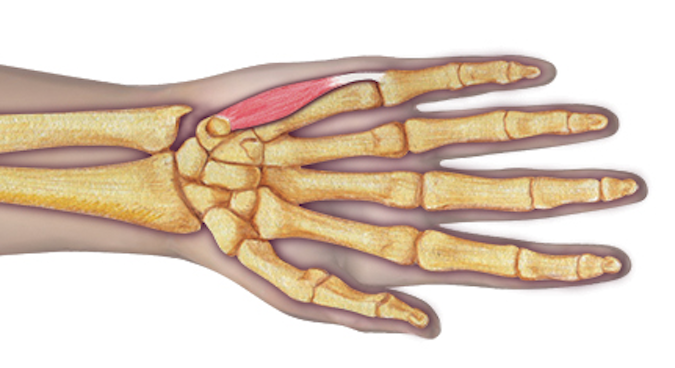 Abductor Digiti Minimi
 -
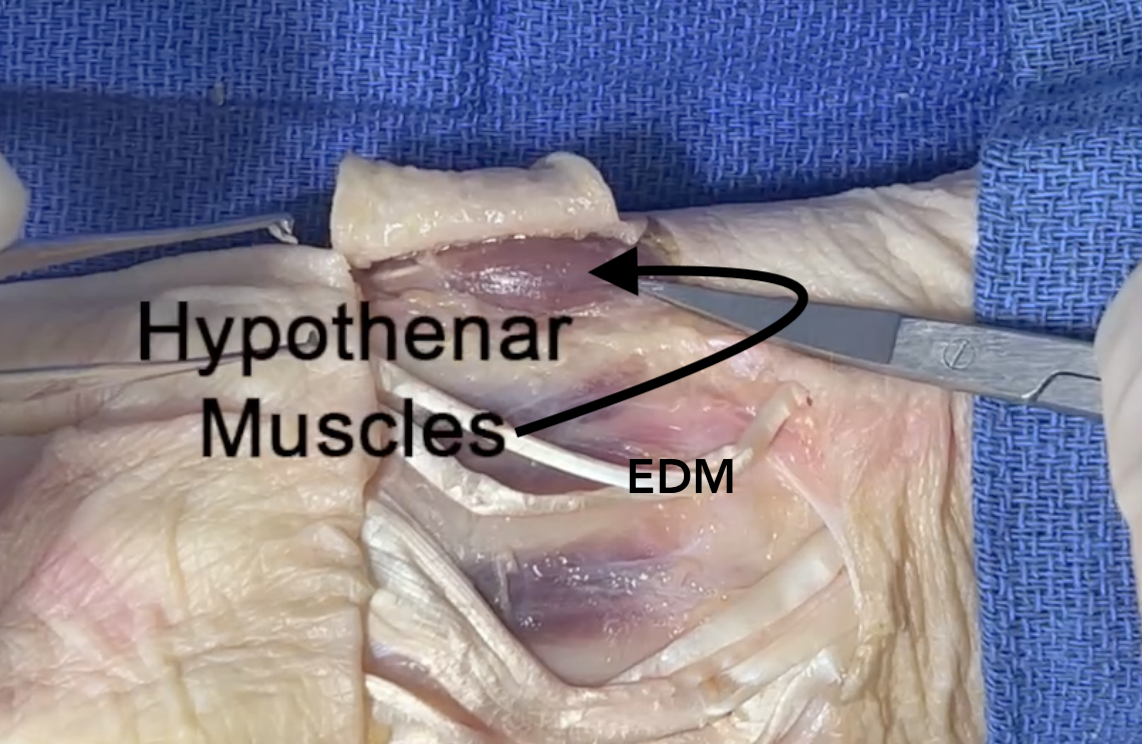 Hypothenar muscles including the abductor digiti minimi as viewed from the dorsal ulnar part of section 9.
 -
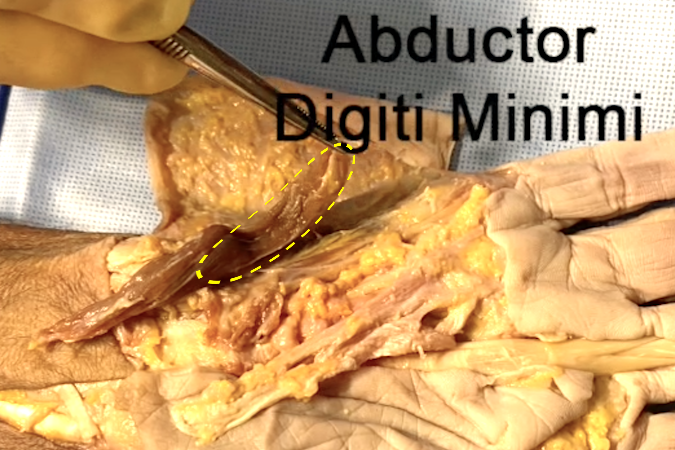 Abductor digiti minimi (yellow ellipse) released from its distal insertion and mobilized on its origin at he pisiform.
 -
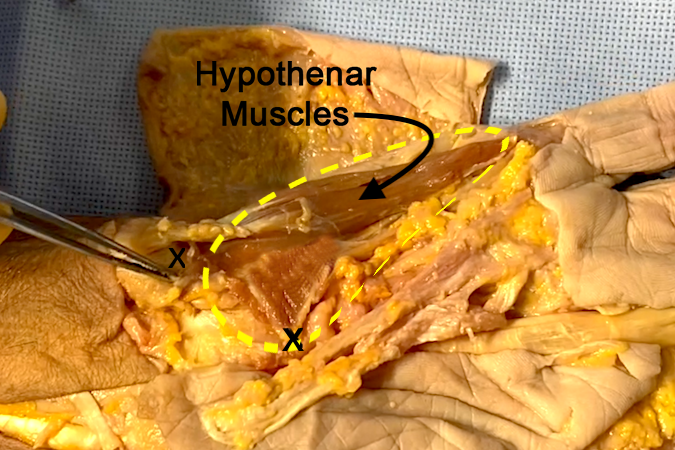 Hypothenar muscles (yellow ellipse) with "X's" marking the pisiform and hook of hamate origins.
Key Points
- A positive Wartenburg's sign occurs when the patient's little finger is in an involuntary abducted position because of a weak third palmar interosseous muscle and contracted and/or unopposed hypothenar muscles.
- The hypothenar muscles can used to perform a opponensplasty muscle transfer to replace the function of the thumb's thenar muscles. In the Huber transfer the hypothenar muscles are released from their distal insertions and mobilized proximally on their neurovascular pedicle and surgically relocated to replace the damaged or denervated thenar muscles.
- Surgical exposure of the deep motor branch of the ulnar nerve often requires release of the hypothenar muscles from their hook of hamate origin.