Central Slip Exam
- Initial examination of the central slip is done by observing the resting position of the PIP joint and by palpating the central slip for tenderness.
- The presence of a boutonniere deformity suggests disruption of the lateral band and/or the central slip. See Boutonniere in Hand Surgery Source for additional details.
- Further assessment of the central slip can be done by evaluating active MP joint flexion and active PIP joint extension.
- See active Range of Motion in Hand Surgery Source for details.
- The integrity of the central slip can also be evaluated by the Elson test. This test can determine the status of the central slip and conjoined lateral bands. The Elson test will be positive when these extensors tendons are cut or ruptured.
- See the Elson Test in Hand Surgery Source for details.
Diagrams & Photos
-
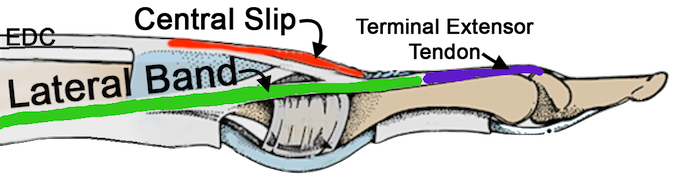 Note central slip (red) part of the extensor mechanism.
Key Points
- The central slip can be damaged by an acute laceration at the level of the dorsal PIP joint but it is more frequently injured by sudden forceful passive flexion of the PIP joint.
- Even a complete central slip laceration can present initially with a minimal PIP extension loss. However, the surgeon should give close attention to this injury in order to avoid a late boutonnière deformity.