Dorsal Ulnar Sensory Nerve Anatomy
- The dorsal ulnar sensory nerve leaves the main ulnar nerve 6-8 cm proximal to the ulnar styloid (6.4 cm. from head of ulna). After separation, this branch passes dorsal to the flexor carpi ulnaris and volar to the ulnar shaft to reach the subcutaneous tissues on the ulnodorsal aspect of the wrist and hand.
- The dorsal ulnar sensory nerve supplies sensation to the dorsoulnar part of the wrist and hand, sensation to the dorsal little finger distally to the distal interphalangeal joint area, and sensation to the dorsal ulnar aspect of the ulnar half of the ring finger.
- The Ulnar Nerve an extension of the medial cord in the brachial plexus. The medial cord originates from the spinal roots C8 and T1.
Diagrams & Photos
-
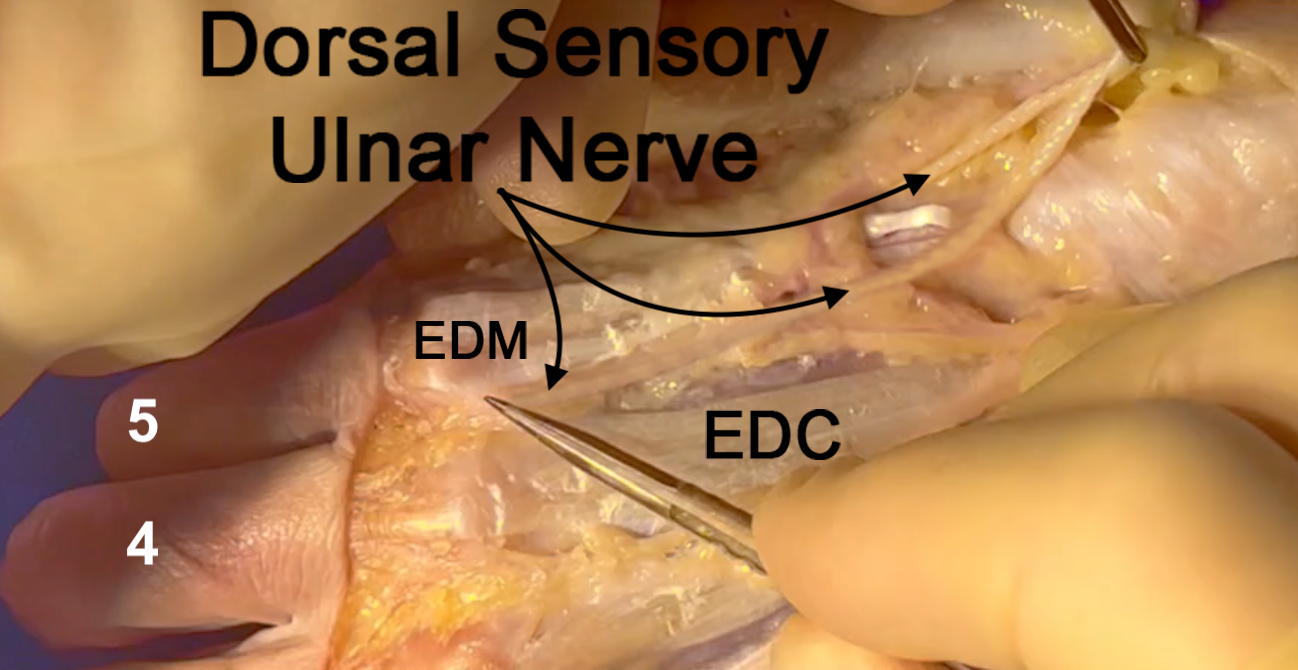 Dorsal Sensory Ulnar Nerve shown in dorsal ulnar part of the hand. 4 (fourth finger), 5(fifth finger), EDC (Extensor Digitorum Communis), and EDM (Extensor Digit Minimi ).
 -
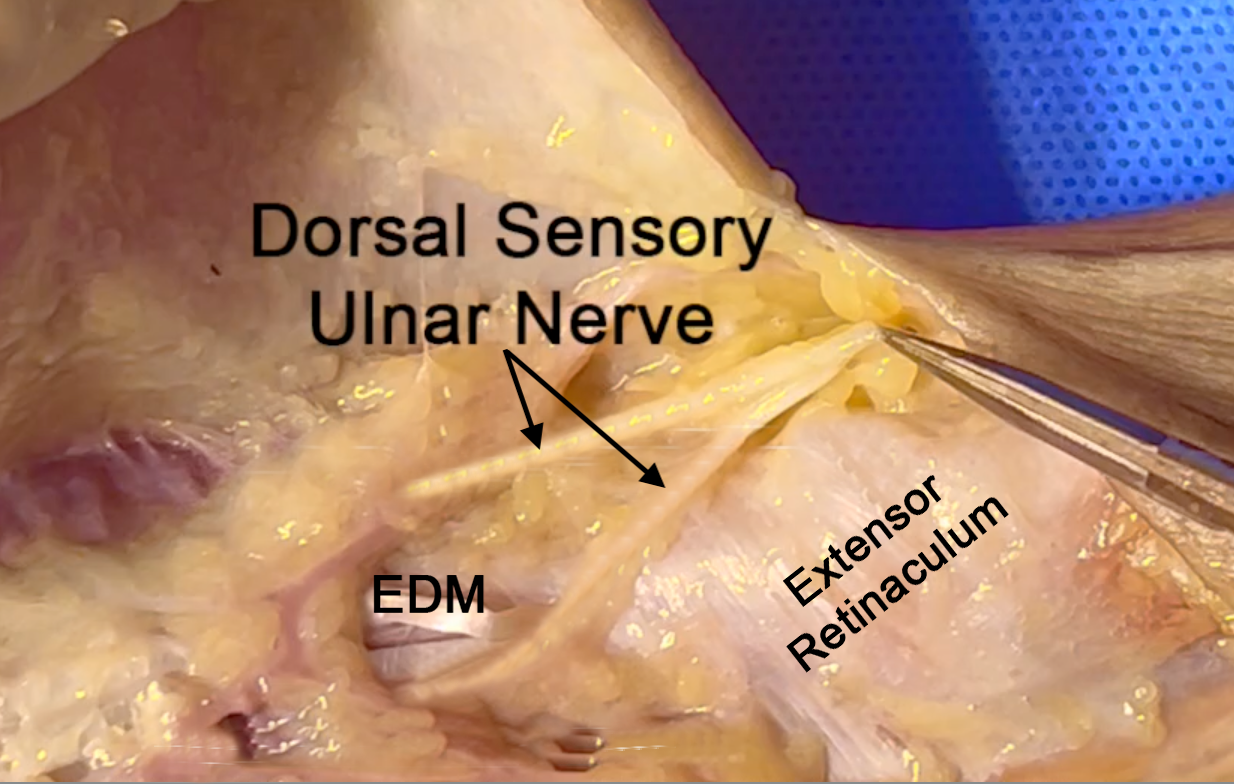 Dorsal Sensory Ulnar Nerve shown in dorsal ulnar part of the wrist and hand. EDM (Extensor Digit Minimi)
 -
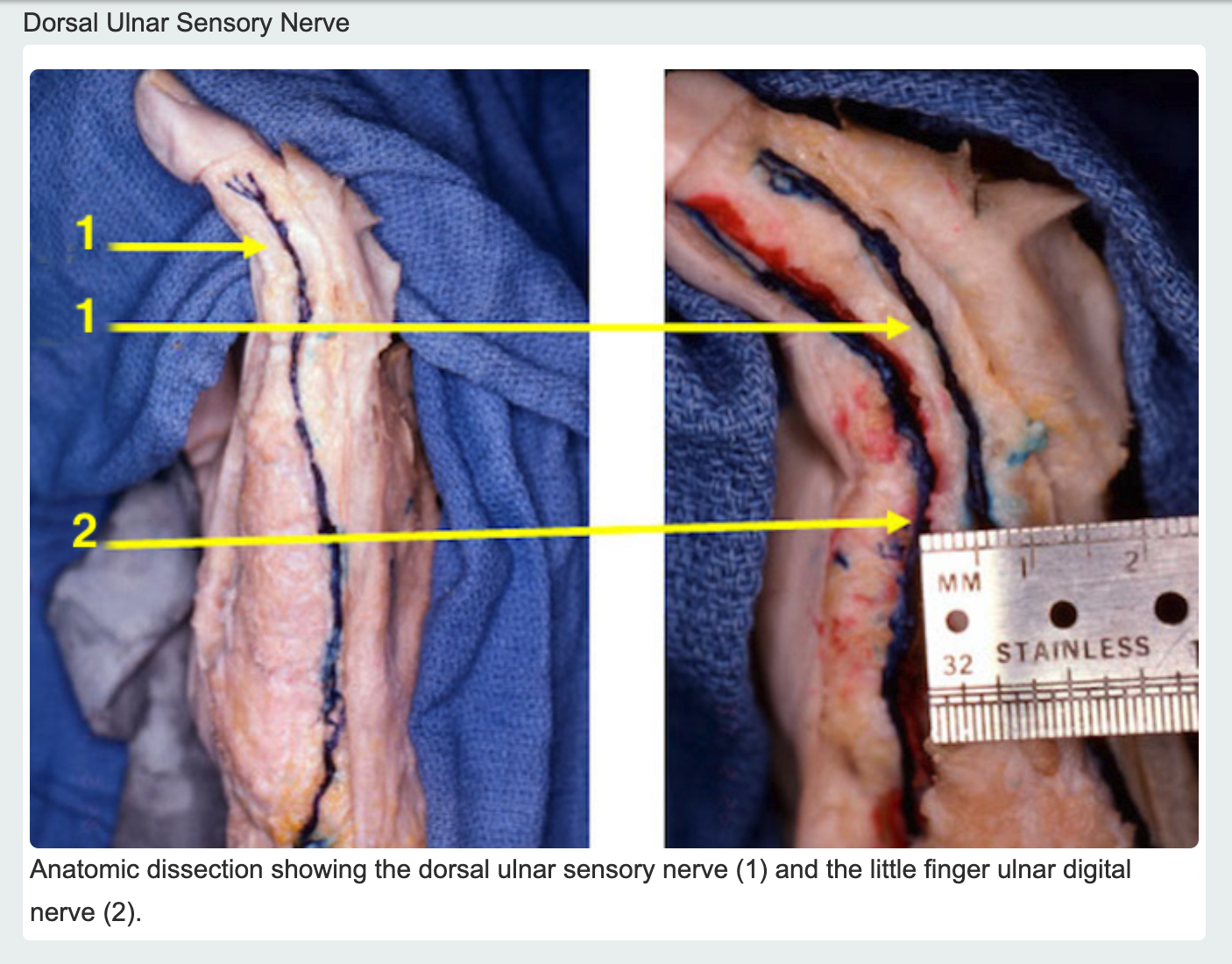 Dorsal Sensory Ulnar Nerve & Fifth Ulnar Digital Nerve
 -
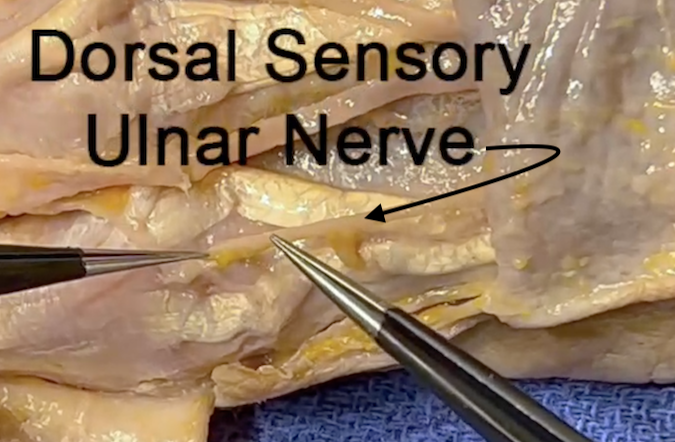 Dorsal Sensory Ulnar Nerve branch at the level of the dorsal ulnar fifth MP joint.
Key Points
- The most likely mechanism causing a dorsal ulnar sensory nerve deficit is a laceration, followed by stretch injuries and contusions.
- The dorsal ulnar sensory nerve has a mean diameter of 2.4 mm and has several branches (average 5). Occasionally there is a dorsal transverse branch at the level of the distal radioulnar joint (DRUJ) which is at risk for injury during surgical exposure of this joint.
- At the base of the little finger the dorsal ulnar sensory nerve is approximately 1 cm dorsal to the ulnar digital nerve of the fifth finger. At this point it is composed of approximately two fascicular groups while the ulnar digital nerve is three fascicular groups. The dorsal ulnar sensory nerve is at risk for injury during Dupuytren’s surgery for pathologic abductor digiti minimi Dupuytren’s cords.
- Cubital Tunnel Syndrome can cause sensory abnormalities in the distribution of the dorsal ulnar sensory nerve.