Index, Long, Ring and Little Flexor Sheaths Anatomy
- The index, long, ring, and little fingers each have five annular pulleys and three thinner flexible cruciate pulleys. These pulleys provide the fibrous component of the flexor tendon’s fibro-osseous tunnel and along with the synovial tissues form the flexor tendon sheath.
- The functions of the pulleys provide a mechanical advantage which allows for a small shortening, i.e. limited excursion, to cause significant rotational motion and torque at the joints. The pulley mechanism also limits bowstringing of the flexor tendons and enhances selective motion of individual joints of the digit. Finally, the flexor sheath (pulleys) produces synovial fluid to facilitate smooth gliding of the flexor tendons (FDP & FDS).
Diagrams & Photos
-
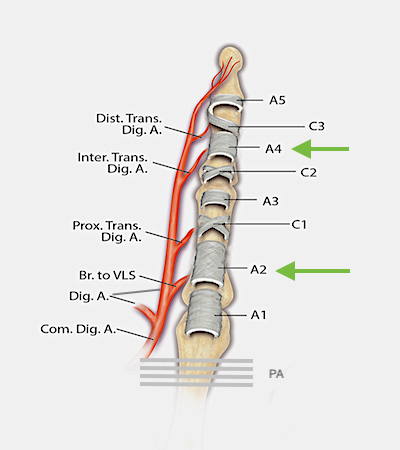 This diagram highlights the vascular supply and components of the flexor tendon sheath. The three cruciate pulleys (C1-3), the five annular pulleys (A1-A5) and the palmar aponeurotic pulley (PA) are shown. The A2 and A4 pulleys (green arrows) are the biomechanically the most important pulleys. During flexor tendon surgery, Tang has shown that the A2 pulley can be 50% excised or vented and the A4 can be 100% vented if needed for tendon excursion if the other parts of the sheath are intact.
Key Points
- The annular pulleys have three layers: 1) the inner layer which secrets hyaluronic acid; 2) the middle structural layer which contains abundant collagen; 3) the outer vascular layer.
- The digital flexor sheathes can become infected.
- An index finger flexor tendon sheath infection can spread to the the thenar space.
- The A2 and A4 are the most important flexor tendon pulleys and should be preserved if at all possible. However, during flexor tendon surgery, Tang has shown that the A2 pulley can be 50% excised or vented and the A4 can be 100% vented if needed for tendon excursion if the other parts of the sheath are intact.