Index Extensor Tendon (Combined EDC & EIP) Exam
Muscle Data
EDC & EIP Muscle Testing (Index Extensor Tendons):
When assessing an injury involving the index extensor tendons, which include the Extensor Digitorum Communis (EDC) and the Extensor Indicis Proprius (EIP), the aim is to determine whether these tendons are fully severed, partially transected, or intact. Initially, ask the patient to actively and gently extend the injured finger(s). For a more detailed examination, position the patient’s hand and upper extremity in pronation, with the wrist in a neutral position, and the metacarpophalangeal (MP) and interphalangeal (IP) joints in a relaxed, slightly flexed posture.
Next, stabilize the patient’s wrist in a neutral position. Place your index finger across the dorsum of all the patient’s index proximal phalanx just distal to the MP joints. Exert resistance in the direction of flexion while instructing the patient to “bend your knuckle back,” which means to straighten or extend the fingers. If the EDC (index) and the EIP tendons are completely lacerated, the patient will be unable to extend the MP joint of the injured index finger, even against zero resistance.
For the EIP exam, maintain the same hand and upper extremity position. Gently passively flex the long, ring, and little fingers into the palm and told them in this flexed position. Next, have the patient attempt to straighten the index finger against resistance. If the EIP is completely lacerated, there will be no active index MP joint extension.
Definition of Positive Result in EDC & EIP Muscle Testing: In muscle testing, a normal result is a positive one. During a normal muscle test, the examiner should observe a normal muscle contraction that can move the joint or tendon against full resistance.
Definition of Negative Result in EDC & EIP Muscle Testing: In muscle testing, an abnormal result is a negative one. During an abnormal muscle test, the examiner should observe an abnormal muscle contraction that cannot move the joint or tendon normaly. In a complete denervation injury, such as a complete radial nerve palsy, there will be no evidence of any muscle contraction (function), and the muscle testing grade will be 0. In a patient with a laceration of the EDC to the index finger or the EIP, the index MP joint may not actively extend due to a complete transection (cut) of the EDC (index) and the EIP tendons. This results in an abnormal or negative muscle testing with no active index MP joint extension. However, these observations also indicate complete EDC (index) and EIP lacerations requiring surgical repair. Thus, this negative muscle testing exam will be positive for a complete EDC and EIP lacerations.
-
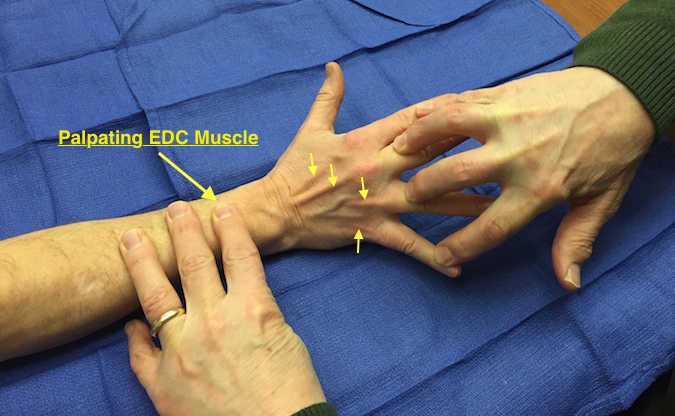 EDC Muscle testing. Note EDC tendon slips (small arrows).
 -
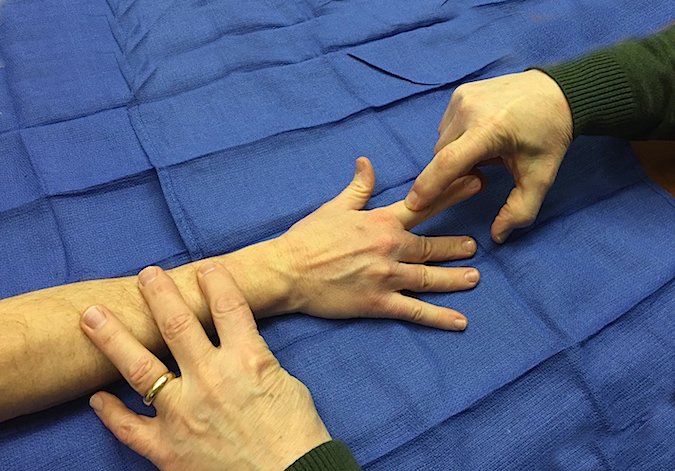 EIP muscle testing
EDC:
- MP extension of the fingers is not a strong motion and only slight resistance is required to “break” the end position.
- It is usual for the active range of motion to be considerably less than the available passive range of motion. In this test, therefore, the “full available range” is not used and the active range is accepted.
- Be aware that the juncturae tendinum can sometimes extend a finger at the MP joint even if the EDC is lacerated completely.
- Another way to check whether there is functional extensor strength in the fingers is to “flick” the proximal phalanx of each finger downward; if the finger rebounds, it is functional.