Lumbrical Muscle Anatomy Section 8
- Origin: FDP tendon in Section 8 at level of the superficial arch.
- Insertion: Radial lateral band (conjoined extensor tendon) at neck of proximal phalanx.
- Innervation: Median nerve C6-T1, ulnar nerve C8-T1.
- Nerve: Lumbricals II and III from median nerve lumbricals IV and V from the ulnar nerve.
- The first and second lumbricals are unipennate and located on the radial side of the index and long FDP tendons in Section 8.
- The third and fourth lumbricals are bipennate and originate from the FDP tendons on either side of the long-ring and ring-little web spaces in Section 8.
Diagrams & Photos
-
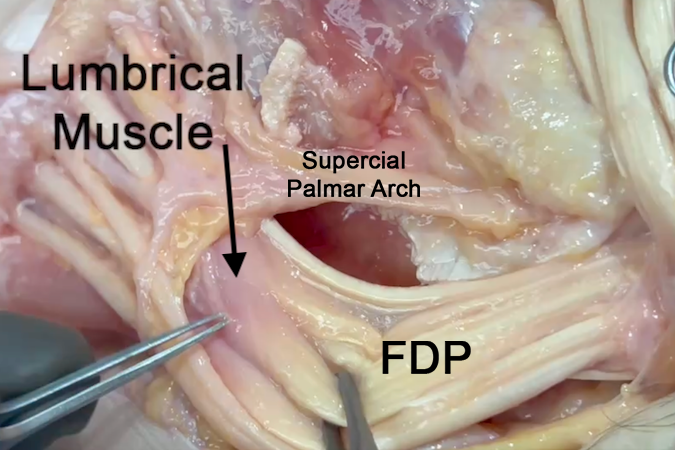 Note the lumbrical muscles at their origin on the FDP tendons. The FDS tendons have been cut distally and pulled out of the carpal tunnel.
 -
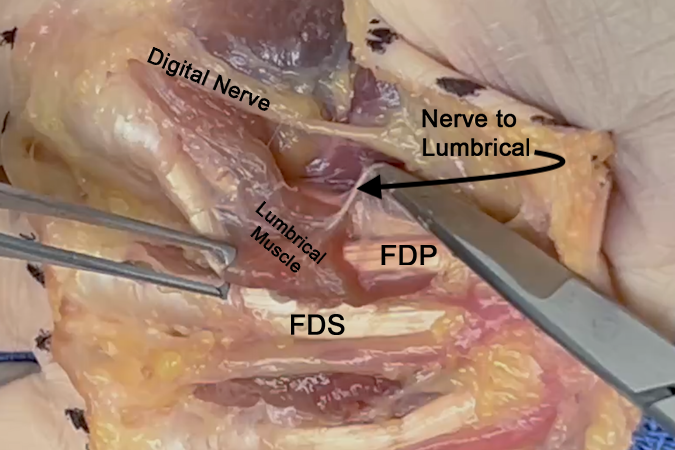 Nerve to the lumbrical muscle.
Key Points
- At the junction of the digital seconds 2, 3, 4, and 5 and palmar Section 7, the lumbricals enter the lumbrical canal which is radial to the sagittal septa and dorsal to the natatory ligaments and deep (volar) to the deep transverse intermetacarpal ligament. Distally it attaches to the radial lateral band.
- In the proximal part of the canal the lumbrical muscle is ulnar to the neurovascular bundle until it passes dorsally to insert into the extensor hood.