Palmar Skin Retention Ligaments
- The palmar fascia is an extension of the palmaris longus.
- The palmar fascia is triangular with the base of the triangle running along the distal edge of Section 7 and the apex of the triangle located proximally at the site of attachment to the palmaris longus.
- The parts of the palmar fascia include the pretendinous bands, the superficial transverse metacarpal ligaments (Skoog’s Ligaments), the commissural ligaments of the first web, and the natatory ligaments.
- The pretendinous bands are the longitudinal components of the palmar fascia. These bands are located superficial too and aligned with the flexor tendons.
- The superficial transverse metacarpal ligaments are also called Skoog’s Ligaments or the transverse ligament of the palmar aponeurosis. These ligaments contribute to the stability of the index, long, ring, and little finger rays and the integrity to the distal palmar transverse arch.
- The natatory ligaments are found in the index-long web, the long-ring web, and the ring-little finger web.
Diagrams & Photos
-
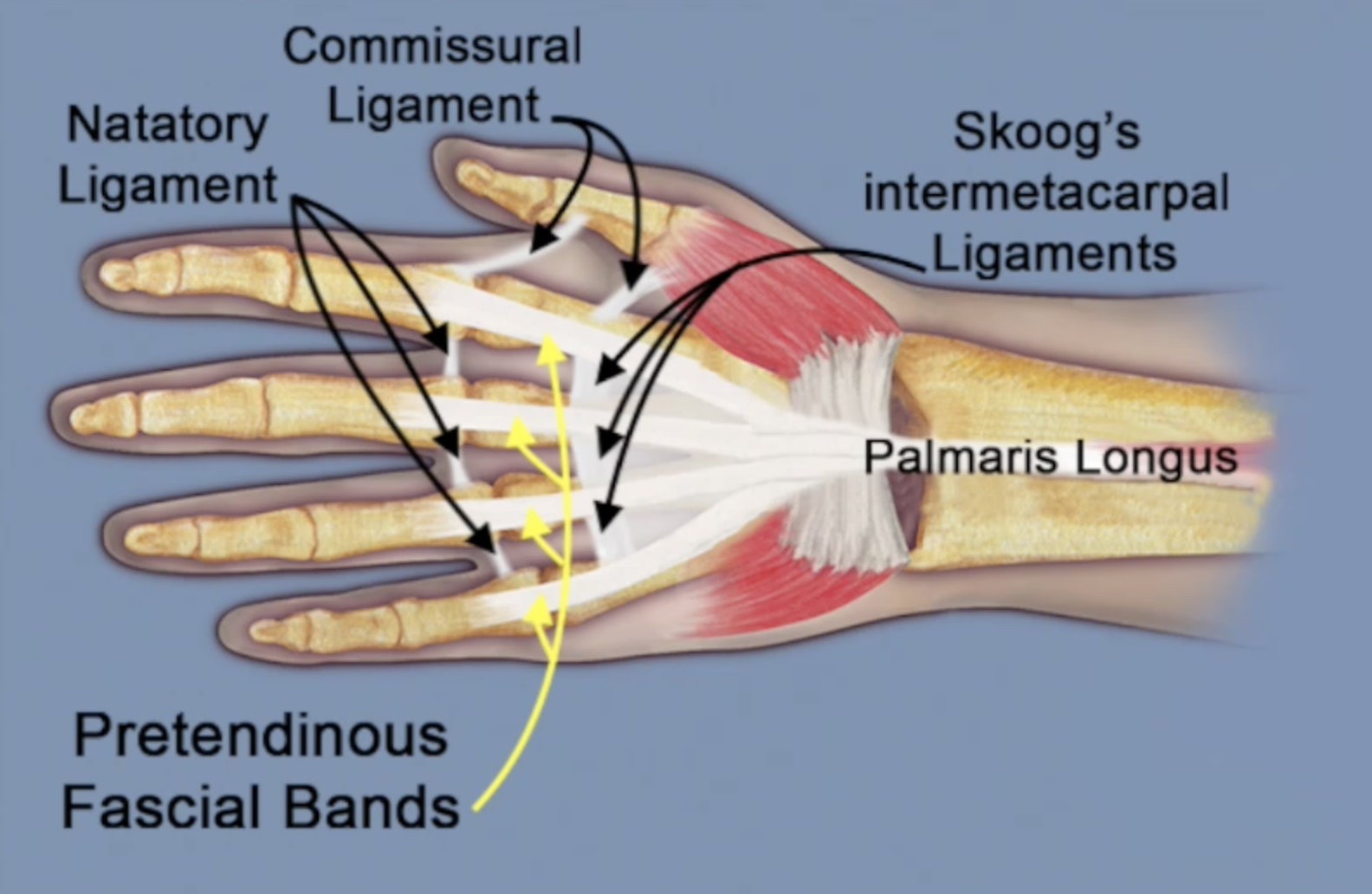 Diagram shows the pretendinous bands, natatory ligaments, commissural ligaments, Skoog's transverse superficial metacarpal ligaments, an the palmaris longus.
 -
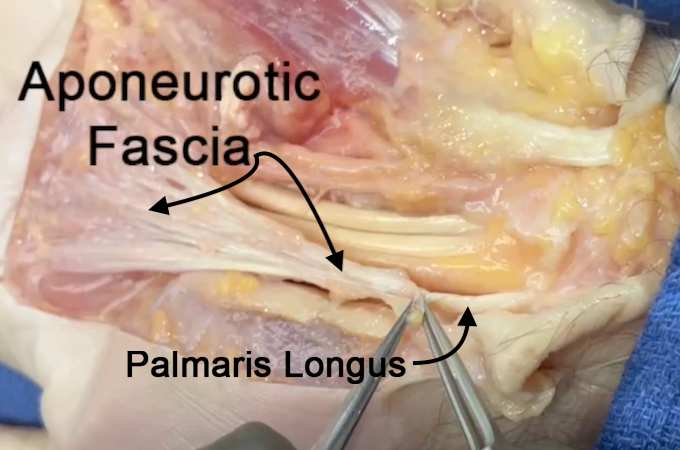 Note palmar aponeurotic fascia and palmari longus sections 7 & 8.
 -
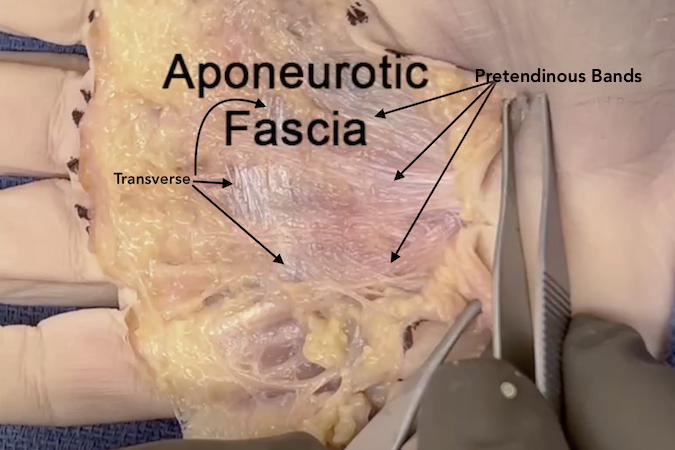 The anatomic dissection shows the pretendinous bands and Skoog's transverse superficial metacarpal ligaments.
Key Points
- In the normal hand the palmar fascia is composed primarily of type 1 collagen.
- At the level of the MP joints, the lumbrical muscles are underneath the transverse superficial metacarpal ligaments and palmar (volar) to the deep metacarpal ligaments. Thus, the superficial and deep metacarpal ligaments represent the ceiling and floor of the lumbrical canal.
- At the distal margin of Section 7 the thin pretendinous bands attached to the skin, the flexor tendon sheath, the spiral bands, and the vertical bands.