Sagittal Band Anatomy
- The sagittal bands are part of the extensor hood at the level of the MP joint. The sagittal bands have two main functions. First, the sagittal bands passively stabilize the extrinsic extensors of the MP joint by keeping extensor tendons in the center of the metacarpal head and MP joint.
- Secondarily, the sagittal bands provide an extension force to the MP joint via their attachments dorsally to the extrinsic extensors (EDC, EIP, and EDM) and their connections to the radial and ulnar volar plate, the deep transverse metacarpal ligaments and the base of the proximal phalanx. The sagittal bands make a fascial sling around the head of the metacarpal and MP joint that lifts the joint into extension when the extrinsic extensors are contracting.
Diagrams & Photos
-
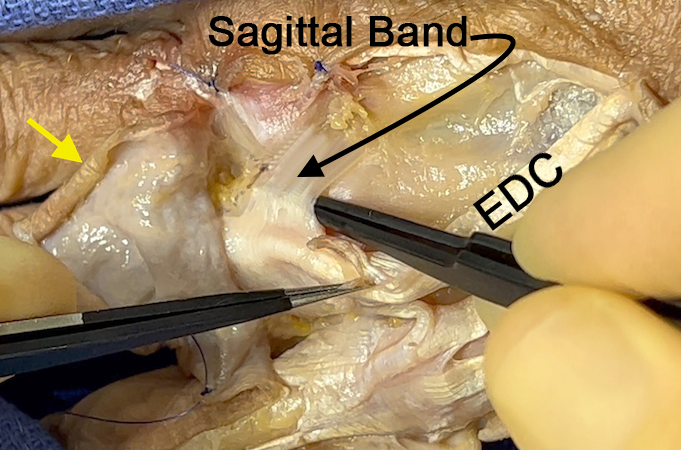 Note the ulnar sagittal band long finger, extensor digitorum communis (EDC), and ring-long web (arrow).
 -
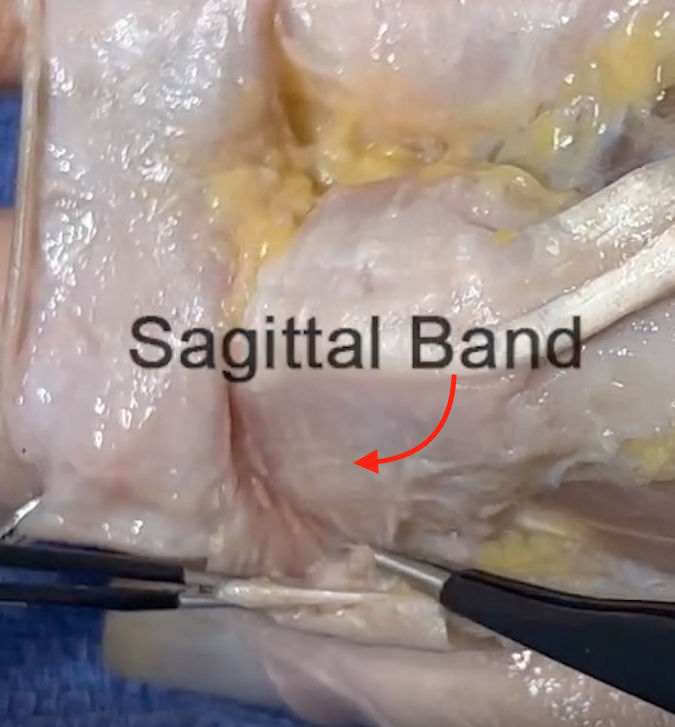 Sagittal Band
Key Points
- The extrinsic extensors (EDC, EIP, and EDM) do not insert into the dorsal proximal phalanges but rather extend the empty joint via the sagittal bands.
- The centralization function of the central bands can be lost if one or both sagittal bands are cut, ruptured, stretched or weakened by hypertrophic synovitis which can be associated with diseases like rheumatoid arthritis or SLE.
- The “boxer’s knuckle” is a closed tendon injury that can involve the sagittal bands at the MP joint level.
- The sagittal bands also limit the extensors excursion and tendon slippage while also preventing extensor tendon bowstringing.
- The sagittal bands work with the juncturae tendinum to stabilize the extensors at the MP joints.