Sagittal Band Exam
The sagittal bands themselves are difficult to see or palpate; however, their normal or abnormal affect on the extrinsic extensor tendons is easy to observe.
If the sagittal bands are functioning normally the extensor tendon can be seen in its normal position in the center of the MP joint both in extension and flexion.
If the sagittal bands are intact the extensor tendon(s) should stay centralized throughout the arc of motion with no sign of the tendon clicking into the radial or ulnar valleys at the web spaces.
When the sagittal bands are intact the patient should have normal full active MP joint extension equal to the uninjured opposite side.
Diagrams & Photos
-
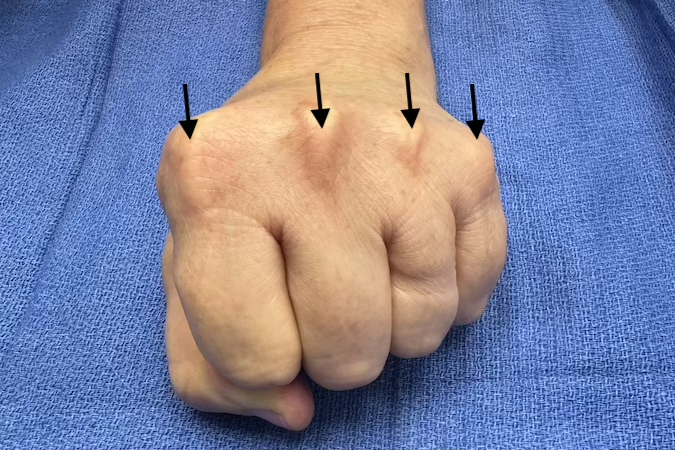 Normal fisted hand with centralized extensor tendons (arrows) secondary to intact radial and ulnar sagittal bands.
 -
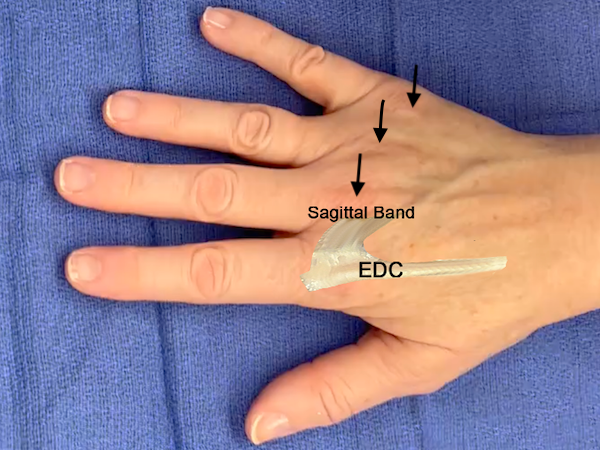 Normal dorsal hand with MP extended. Note the EDC and sagittal band overlay and the normal centralized extensors tendons (arrows).
 -
 Sagittal bands index and long fingers (arrows).
 -
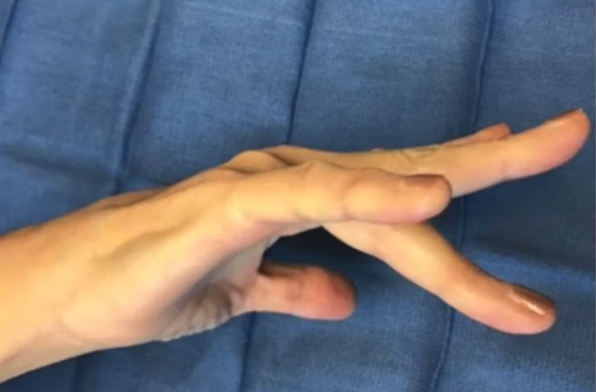 Incomplete long finger active extension secondary to ruptures sagittal band.
 -
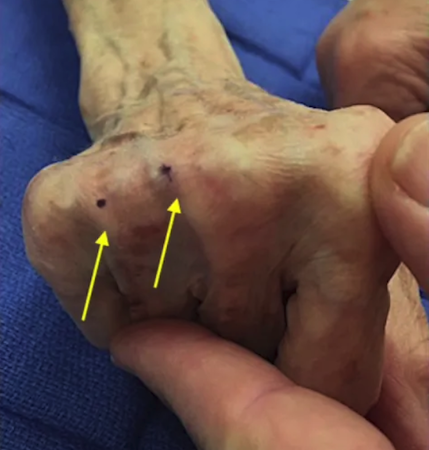 Note the central location of the extrinsic extensors (arrows) in the fisted hand with normal sagittal bands.
 -
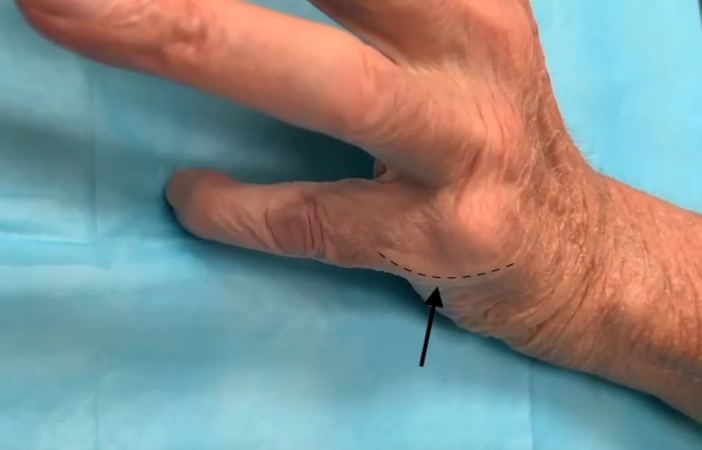 Fifth MP joint locked in flexion secondary to ruptured radial sagittal band and ulnarly subluxated extensor tendons.
Key Points
- A patient with a ruptured sagittal band(s) can not initiate active extension of the flexion finger. However, if the finger is placed in full extension passively then the patient can actively told the finger in full MP joint extension.
- Because the EDC has a single muscle belly and because the extensors are interconnected by the juncturae tendinae and the tethering sagittal bands. the extensors will demonstrate the extensor quadriga phenomenon which potentiates group MP joint extension and limits isolated individual finger MP joint extension.
- Extensor tendon subluxation secondary to a ruptured sagittal band can lead to interosseous tightness and a secondary swan neck finger deformity.