Extensor Carpi Radialis Brevis Exam
Origin: Humerus (lateral epicondyle via common forearm extensor tendon
Radial collateral ligament of elbow joint
Aponeurosis of muscle
Insertion: 3rd metacarpal bone (base of dorsal surface on radial side)
2nd metacarpal (occasionally)
Innervation: Cervical root(s): C7 and C8
Nerve: Radial nerve (posterior interosseous branch)
ECRB Muscle Testing:
When examining the dorsal wrist for signs of an acute traumatic ECRB laceration, the goal is to determine if the ECRB tendon is completely lacerated, partially transected or intact. When examining the function of an uninjured ECRB musculotendinous unit for a chronic condition like cerebral palsy, the 0 to 5 muscle testing grading system is used. In this system zero is a complete loss of extensor carpi radialis brevis ECRB contraction and wrist extension motion and a grade of 5 is normal ECRB function that can contract against normal resistance. A complete description of graded muscle testing is available below. Usually, a complete muscle testing cannot be performed in the face of any acute laceration secondary to pain and tenderness. The examiner may have to rely on the observation that the laceration occurred in the dorsal section 10 containing the ECRB. However, the examiner should test the contraction of the potentially injured musculotendinous unit as thoroughly as possible. The exam goal is to determine preoperatively if the tendon is cut, partially cut, or intact. If the exam suggests a cut or significantly partially cut tendon, then surgery is indicated.
To examine the ECRB, position of patient's hand and upper extremity with the forearm in pronation, the wrist in neutral with palmar side of the wrist and hand resting on the table.
The examiner then uses the table to support the palmar side of the patient's wrist and the examiner’s hand stabilizes the forearm. Next the examiner applies pressure with the opposite hand to the dorsal surface of the 2nd through 5th metacarpals to gently resist the patient’s attempt to actively extend the wrist joint. The examiner then instructs the patient to “Bring your wrist up. Hold it. Don’t let me push it down.” Some suggest “bend your wrist back” Again, the resistance to wrist extension will vary according to the discomfort created by the examination.
Definition of Positive Result in ECRB Muscle Testing: A normal result is a positive one. During a normal muscle test, the examiner should observe a normal muscle contraction that can extend the wrist joint against resistance.
Definition of Negative Result ECRB Muscle Testing: Note the ECRB tendon by observation and palpation. In muscle testing, an abnormal result is a negative one. During a partially abnormal muscle test, the examiner should observe an abnormal muscle contraction that cannot move the joint or only move it against minimal resistance. In a complete denervation injury, such as a complete radial nerve palsy, there will be no evidence of any muscle contraction, and the muscle testing grade will be zero.
In a patient with a laceration of the ECRB, the wrist joint may not actively extend at all or partially depending on the status of the ECRB and the simultaneous status of the other two wrist extensors (the ECU and ECRL). If any of the three wrist extensors (ECU, ECRB, or ECRL) are intact, the wrist may extend despite complete lacerations of the other two wrist extensors. Therefore, it is important to palpate the individual extensor tendons during the exam to determine their status while observing overall active wrist extension and the force of extension. If the wrist extensors are not functioning properly, this will result in an abnormal or negative muscle testing or possibly a grade 3 because of muscle belly contraction without active wrist joint extension. Because a single wrist extensor can actively extend the wrist, it is also important to assess the force of extension and compare the extension force and the palpation of the individual tendons to the opposite uninjured side. These observations may indicate a complete ECRB laceration which needs surgical repair. Therefore, this negative muscle testing exam may be positive for an ECRB complete laceration.
-
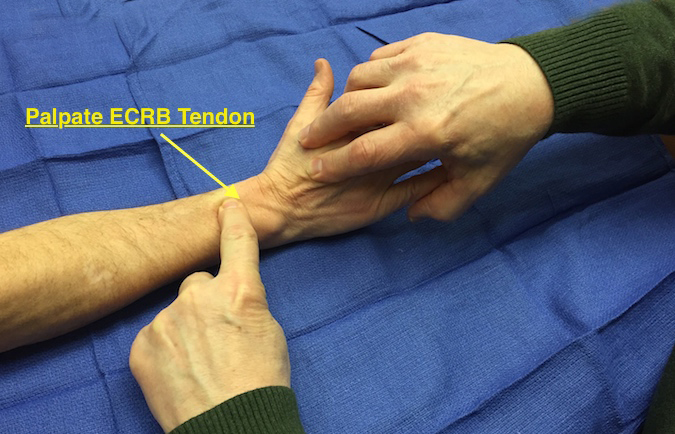 ECRB exam
 -
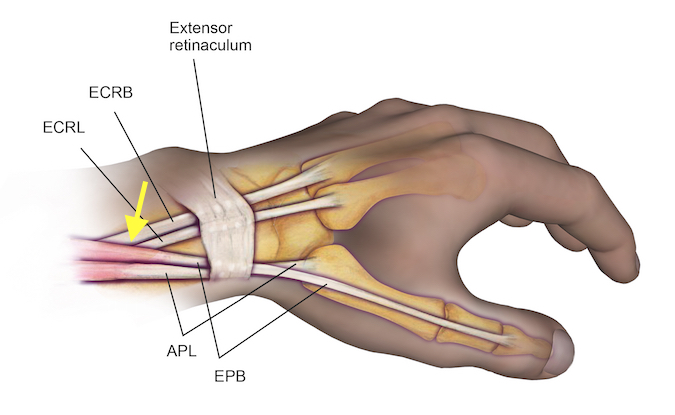 Intersection Syndrome is caused by inflammation in the area (arrow) between the radial wrist extensors (ECRB&ECRL) and the thumb abductor and extensor (APL & EPB).
- If the ECRB is the only remaining wrist extensor then the ECRB will extend the wrist in neutral radial and ulnar deviation.