Extensor Pollicis Brevis (EPB) Exam
EPB Muscle Data:
- Origin: Radius (dorsal surface of the distal third of the radius inferior to the origin of the EPL) and the adjacent interosseous membrane.
- Insertion: Thumb MP joint dorsal joint capsule and the dorsal base of the proximal phalanx of the thumb.
- Innervation: Cervical roots - C7 and C8
- Nerve: radial nerve (posterior interosseous branch)
EPB Muscle Testing:
When examining the dorsal thumb for signs of an acute traumatic EPB laceration, the goal is to determine if the EPBtendon is completely lacerated, partially transected or intact. When examining the function of EPB musculotendinous unit for a chronic problem like cerebral palsy, the 0 to 5 muscle testing grading system is used. In this system grade zero is a complete loss of extensor pollicis brevis (EPB) function with no detectable muscle contraction and a grade of 5 is normal EPB function that can contract against normal resistance. A complete description of graded muscle testing is available below. Usually, a complete muscle testing cannot be performed in the face of an acute laceration secondary to pain and tenderness. The examiner may have to rely on the observation that a laceration occurred in the dorsal section occupied by the EPB and EPL. However, the examiner should test the contraction of the potentially injured musculotendinous unit as thoroughly as possible. The exam goal for acute lacerations is to determine without exploratory surgery if a tendon is cut, partially cut, or intact. If the exam suggests a cut or significantly partially cut tendon then surgery is indicated.
To examine the EPB, position of patient's hand and upper extremity with the forearm in mid-rotation, wrist in neutral with ulnar side of hand resting on the table and the thumb in a flexion or resting posture. Some suggest that for Grades 0-2, the patient places his/her forearm in pronation with wrist in neutral and thumb in relaxed position to start.
The examiner then uses the table to support the ulnar side of the patient's hand and the examiner’s hand to stabilize the proximal phalanx of the thumb. Next, the examiner applies pressure with his hand to the dorsal surface of the thumb’s proximal phalanx to gently resist the patient’s attempt to actively extend the thumb MP joint. The examiner then instructs the patient to "straighten your thumb and hold it. Don't let me push your thumb down." Again, the resistance to extension will vary according to the discomfort created by the examination.
Definition of Positive Result in EPB Muscle Testing: A normal result is a positive one. During a normal muscle test, the examiner should observe a normal EPB muscle contraction that can extend the MP joint against resistance.
Definition of Negative Result EPL Muscle Testing: In muscle testing, an abnormal result is a negative one. During a partially abnormal muscle test, the examiner should observe an abnormal muscle contraction that cannot move the joint or only move it against minimal resistance. In a complete denervation injury, such as a complete radial nerve palsy, there will be no evidence of any muscle contraction or MP extension. Therefore, the muscle testing grade will be zero. In a complete EPB laceration there will be some muscle contraction but no active extension of the thumb MP joint, secondary to the transection (cut) of the EPB tendon. This will result in an abnormal or negative muscle testing. Thesse observations will also indicate a complete EPB laceration which needs surgical repair. Therefore, this negative muscle testing exam will be positive for an EPB complete laceration.
-
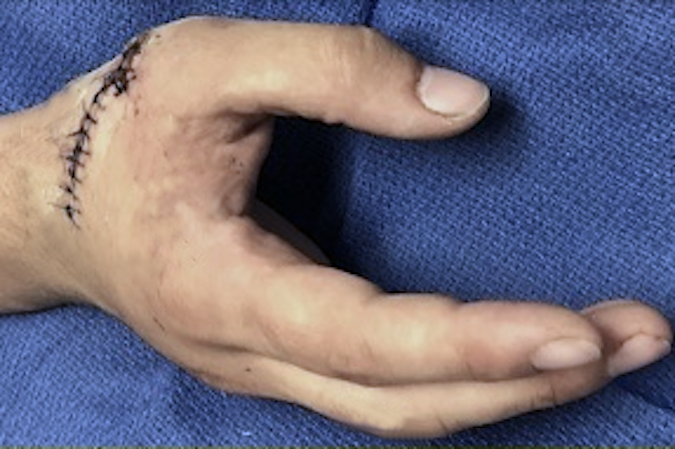 Thumb with lacerated EPL, EPB, and APL. Note lack of thumb abduction, thumb MP extension, and thumb IP extension.
 -
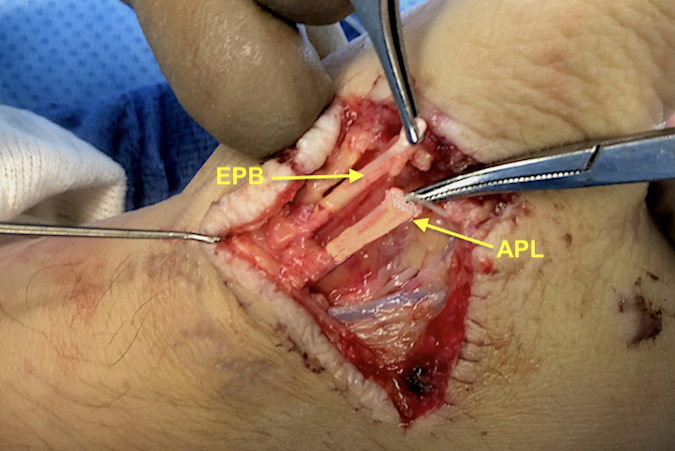 Laceration at base of thumb with laceration of EPB and APL tendons.
- The EPB presence and anatomic size is variable.
- The EPB enters the radial aspect of the wrist with the abductor pollicis longus via the first extensor compartment.
- Isolating the EPB for independent muscle testing is difficult.