Terminal Extensor Tendon Exam
- The first step in the exam of the terminal extensor tendon is to observe the presence or absence of a DIP joint extension lag.
- The second step in the exam of the terminal extensor tendon is to look for swelling, ecchymosis, and tenderness at the tendon's insert site on the dorsum of the distal phalanx.
- The third step is to gently assess the active and passive range of motion of the DIP joint.
Diagrams & Photos
-
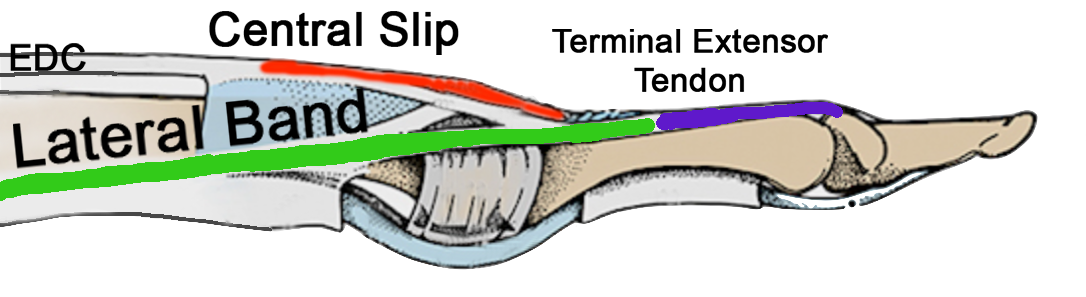 Terminal extensor tendon in purple.
Key Points
- The terminal extensor tendon laceration or rupture is the cause of a mallet finger injury.
- Mallet finger injuries can leave the finger with a swan neck deformity.
- The swan-neck deformity can also be caused by a ruptured volar plate at the PIP joint.
- The terminal extensor tendon is a very small structure which makes surgical repair difficult even with acute sharp lacerations.
- Closed injuries to the terminel extensor tendon, like a mallet finger injury, typically shred the terminal tendon making open surgical repair impossible in most cases. Therefore, mallet fingers are treated with closed extension splinting.