Second Palmar (Volar) Interosseous Muscle Exam
Origin: the palmar interosseous muscles are unipennate muscles originating from the palmar ulnar side of the index finger metacarpal and from the radial side of the ring, and little finger metacarpal bones.
Function: the palmar interosseous muscles adduct the fingers towards the long metacarpal and assists in flexion of the MP joints and extension of the PIP and DIP finger joints.
Insertion: Dorsal extensor expansion (extensor aponeurosis)
Innervation: Cervical roots): C8-T1
Nerve: Ulnar Nerve (deep ulnar motor branch)
- The interossei muscles are in the deepest layer of hand muscles and contained in a strong fascial compartment.
Diagrams & Photos
-
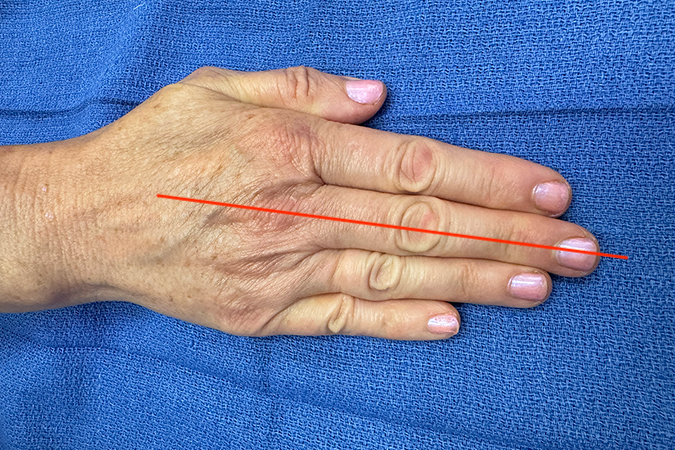 The palmar interosseous muscles adduct the fingers towards the central long finger ray (red line).
 -
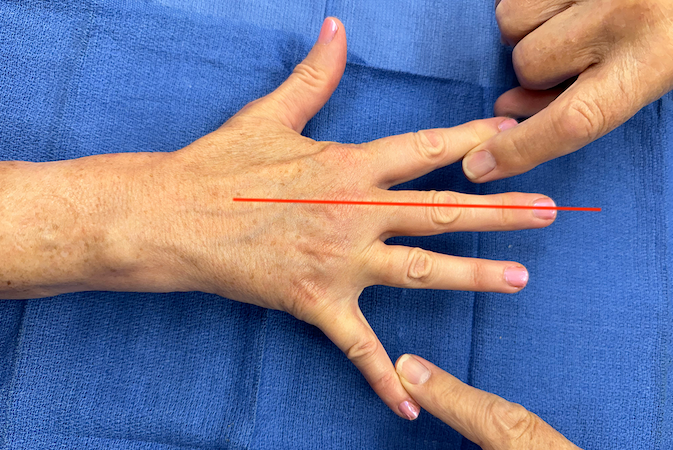 Fingers adducting towards the central long finger ray (red line) against resistance during muscle testing of the palmar interosseous muscles.
 -
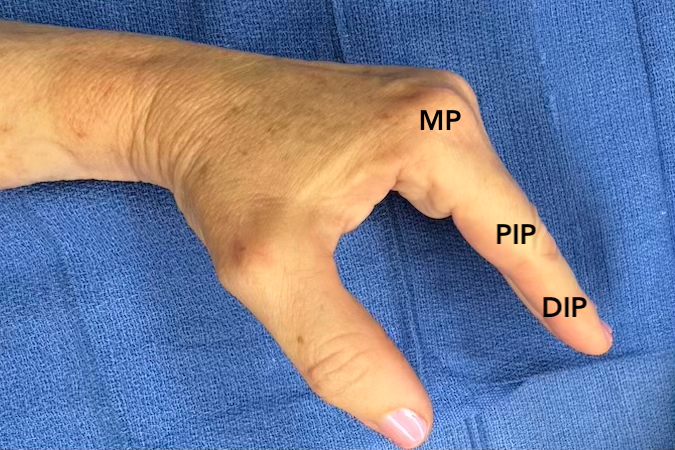 The interossei contribute to the intrinsic plus position by flexing the MP joints and extending the PIP and DIP joints.
Key Points
- The palmar interosseous muscles dorsal to the deep interosseous ligament but volar to the MP joint axis of motion.
- The interossei muscles can be damaged by increased compartment pressures associated with intrinsic compartment syndrome.
- Contracted palmar interosseous muscles can lead to intrinsic tightness that limits active finger flexion.