Conjoined Lateral Band Exam
- Initial examination of the conjoined lateral band is done by observing the lateral band, observing the resting position of the PIP joint and by palpating the lateral band for tenderness.
- The presence of a boutonniere deformity suggests disruption of the lateral band and/or the central slip. See Boutonniere in Hand Surgery Source for additional details.
- Further assessment of the conjoined lateral bands can be done by evaluating active MP joint flexion and active PIP joint extension.
- See active Range of Motion in Hand Surgery Source for details.
- The integrity of the lateral band can also be evaluated by the Elson test. This test can determine the status of the central slip and conjoined lateral bands. The Elson test will be positive when these extensors tendons are cut or ruptured. See the Elson Test in Hand Surgery Source for details.
- Intrinsic tightness should be expected in non-acute patients complaining that they are having difficulty making a fist. The conjoined lateral band should also be evaluated for its potential contribution to intrinsic tightness by performing a Bunnell intrinsic tightness test. See active Bunnell Tightness Test in Hand Surgery Source.
Diagrams & Photos
-
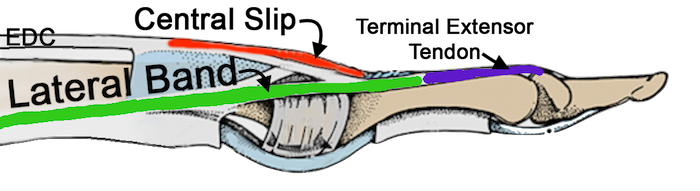 Conjoined lateral band and other extensor tendons
 -
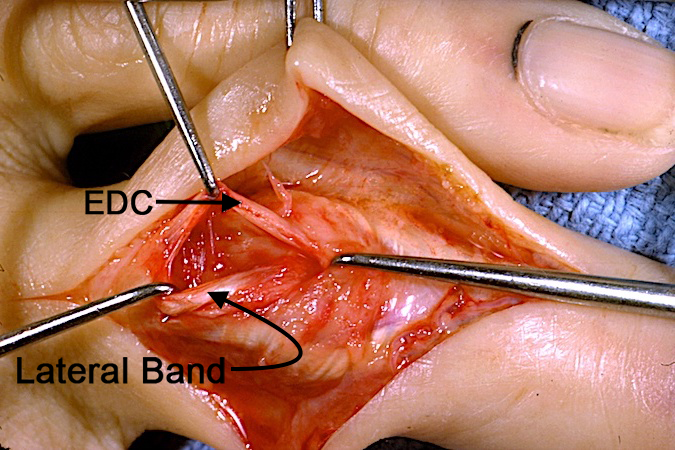 Surgical image showing the EDC and the lateral band
 -
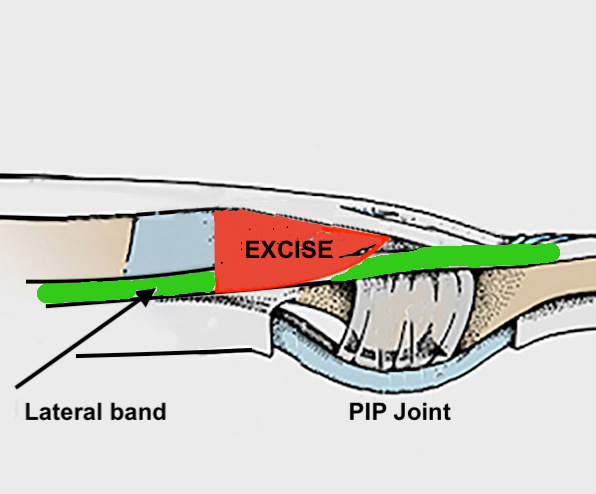 The red area is excised during a intrinsic release for intrinsic tightness.
Key Points
- The conjoined lateral bands are kept dorsal to the PIP joint's axis of rotation by their attachments to the triangular ligament and the central slip.
- The lateral band is attached to the central slip by the lateral bands.
- The triangular ligament is located on the dorsal proximal edge of the middle phalanx.