Palmar Skin Retention Ligaments
- In the normal hand the thin fibers of the palmar fascia are not palpable or visible on examination.
- During active range of motion, the positional stability of the palmar skin is maintained by the retention ligaments of the palmar fascia. These fascial structures also maintain the stability of the neurovascular structures, flexor tendons and bones of the palm and digits.
Diagrams & Photos
-
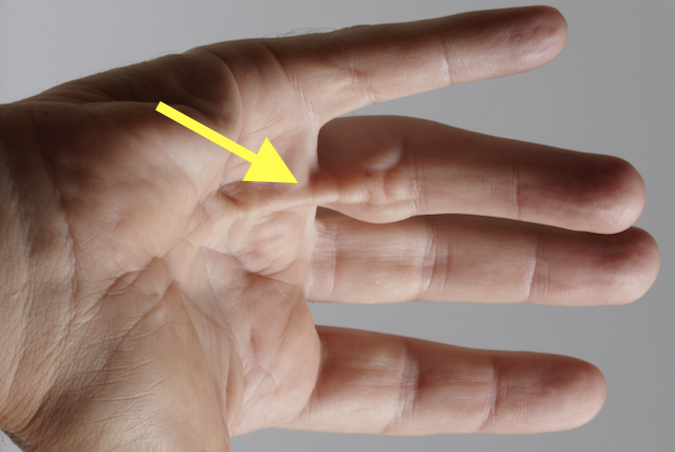 Long finger showing an MP joint flexion contracture secondary to a classic Dupuytren's disease central cord (yellow arrow).
 -
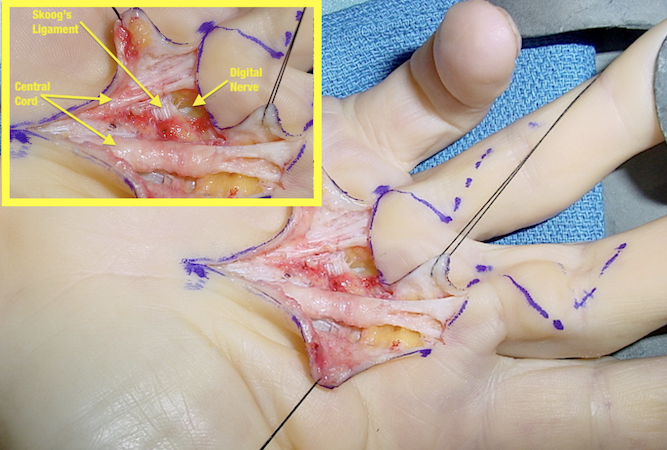 Dupuytren's disease central cords to the long and ring fingers. Insert shows the central cords, Skoog's ligaments, and the common digital nerve.
Key Points
- In Dupuytren’s disease the components of the palmar fascia, particularly the pretendinous bands and the natatory ligaments thicken and shorten.
- In Dupuytren’s disease the pretendinous bands known as central cords in the disease state are visible and palpable.
- As central cords of Dupuytren’s disease thicken and shorten they restrict active range of motion and cause flexion contractures.
- In a normal hand exposure of the flexor tendon sheath during trigger finger surgery requires cutting the thin tiny pretendinous bands.
- In patients with Dupuytren’s disease, the central cord which represents a thicken and shorten pretendinous band that should be partially excised during exposure of the flexor tendon sheath for trigger release.