Opponens pollicis (OP) Exam
Opponens Pollicis Muscle Data
- Origin: Trapezium bone and flexor retinaculum.
- Insertion: Radial side of the shaft of the first metacarpal bone.
- Innervation: Median nerve.
- Nerve: Recurrent motor branch of the median nerve
Opponens Pollicis Muscle Testing
When assessing a thumb injury for signs of opponens pollicis (OP) laceration, the aim is to determine whether the opponens pollicis muscle is fully lacerated, partially transected, or intact. While assessing this muscle, the examiner must also recognize that isolated OP lacerations are uncommon and typically OP injury is part of a thenar muscle group injury. The examination of an uninjured OP involves the 0 to 5 muscle testing grading system particularly in chronic conditions like cerebral palsy. Zero indicates a complete loss of OP contraction, and a grade of 5 represents normal OPfunction, capable of contracting against normal resistance. Comprehensive details on graded muscle testing are provided below. Conducting a full muscle test in the case of acute laceration can be challenging due to pain and sensitivity. Nonetheless, the examiner should assess the contraction of the potentially injured musculotendinous unit as thoroughly as possible. The primary goal is to determine preoperatively if the muscle is fully, partially cut, or intact. To assess the OP, the patient's hand and upper extremity should be positioned with the forearm in mid-rotation and the wrist in a neutral position, with the ulnar side of the hand resting on the table. The thumb should be in a resting posture.
The examiner stabilizes the hand and instructs the patient to "Bring your thumb to your little finger and touch the two pads, forming the letter 'O' with your thumb and little finger." This tests the opponens pollicis' ability to perform thumb opposition. The resistance to this movement will vary based on the examination's discomfort and the degree of damage to OP Muscle.
Definition of Positive Result in OP Muscle Testing: A normal result is a positive one. During a normal muscle test, the examiner should observe a normal muscle contraction that can move the joint or tendon against full resistance.
Definition of Negative Result in OP Muscle Testing: The thenar muscles including the OP muscle should be observed, palpated, and compared to the uninjured side. An abnormal result in muscle testing is a negative one. During a partially abnormal muscle test, the examiner should observe an abnormal muscle contraction that can move the joint or tendon but not against normal resistance. In a complete denervation injury, such as a median motor branch laceration or a complete median nerve palsy, there will be no evidence of muscle contraction, and the muscle testing grade will be zero.
In a patient with a laceration affecting the OP muscle, the thumb may not be able to perform opposition at all due to a complete transection of the muscle. This results in an abnormal muscle testing. However, these observations also indicate a potentially complete OP muscle laceration requiring surgical repair. Therefore, this negative muscle testing exam will be positive for a probable OP laceration.
-
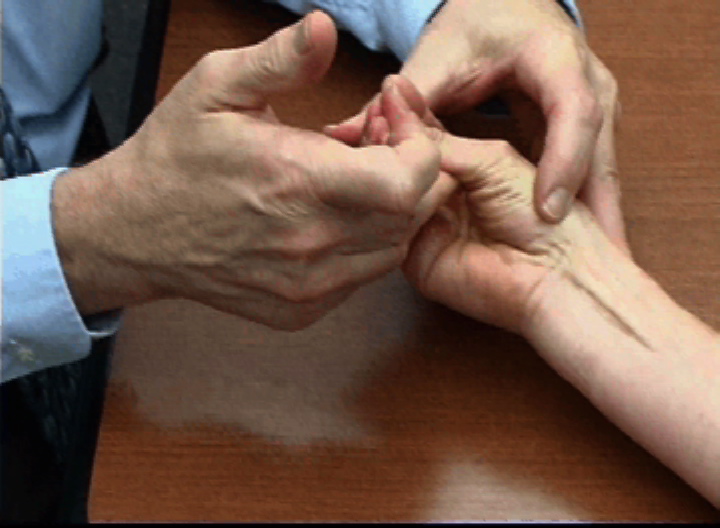 The median nerve innervated muscles: abductor pollicis brevis, the flexor pollicis brevis superficial head, and the opponens pollicis (APB, FPB, & OP) are tested together as a single unit. Their contraction is assessed by the examiner's left index finger while applying resistance.
 -
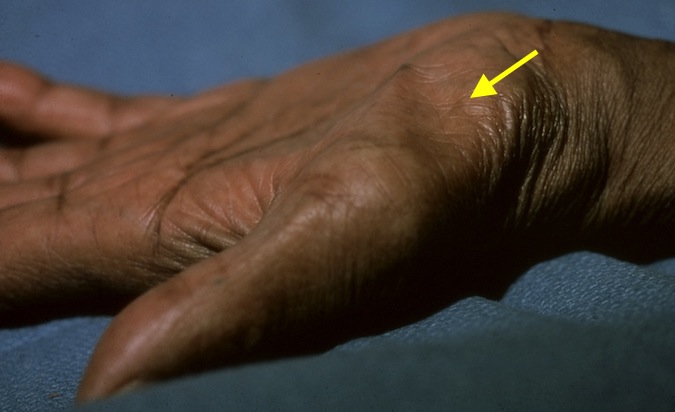 Observation can identify atrophy (arrow) of the thenar muscles (APB, FPB, and OP).
- The opponens pollicis can be palpated along the radial dorsal edge of the thumb metacarpal.
- With the hand palm down on a flat surface, the median innervated thenar muscles are at risk for injury during a deep laceration into the metacarpal part of the dorsal section 1 (thumb) of the anatomic structures at risk occurs.
- The flexor pollicis longus divides the thenar muscles into the group innervated by the median nerve and the ulnar nerve innervated group. The ulnar nerve innervated group includes the adductor pollicis and the deep head of the flexor pollicis brevis.