Little Proximal Interphalangeal (PIP) Joint Anatomy
The Finger PIP Joint provides an articulation between:
- Proximal Phalanx: The bone of the index located between the metacarpophalangeal (MP) joint and the PIP joint.
- Middle Phalanx: The middle phalanx of the finger located between the metacarpophalangeal (PIP) joint and the DIP joint.
- At the PIP joint, the proximal phalanx has a convex shaped head, and the middle phalanx has a concave base. The PIP joint has complex biomechanics in part because these bone surfaces are not perfectly congruent.
Ligaments
- Collateral Ligaments: The proper and accessory collateral ligaments are located on the ulnar and radial sides of the PIP joint and stabilize the joint from side-to-side movements (lateral stress).
- Volar Plate: Located on the palmar side of the PIP joint, it prevents hyperextension and provides joint stability.
The flexor tendons crossing the Finger PIP joint are:
- FDP: This tendon flexes the MP, PIP, and DIP joints.
- FDS: This tendon flexes the MP and PIP joints.
The finger PIP joint type:
- The finger interphalangeal (PIP) joint is a uniaxial hinge (ginglymoid) joint. This joint allows the phalanges to have primarily a flexion/extension arc of motion.
- Synovial joint
- Synovial joints are specialized structures that allow movement at bony articulations.
- Composed of a joint cavity lined by synovium containing bones covered with articular cartilage
- Structural components contain:
- Articular cartilage - enables low friction movement
- Ligaments – stabilize a functional range of motion
- Joint capsule - Fibrous tissue surrounding joint cavity
- Synovium - Tissue lining non-cartilaginous portions of joint cavity and is composed of two layers, the intimal lining and the connective tissue sublining
- Synovial fluid - Joint lubricant produced and regulated by the synovium
Diagrams & Photos
-
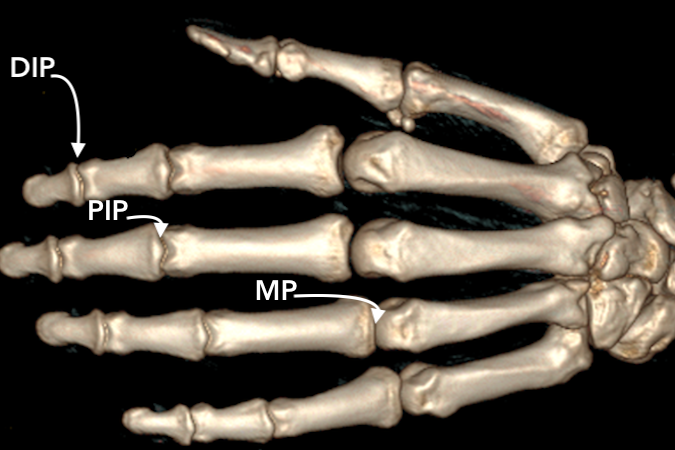 CT Reconstruction showing DIP, PIP, and MP joints.
 -
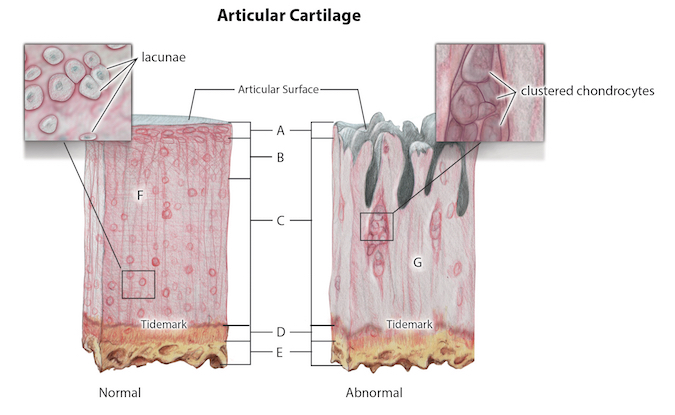 Normal and arthritic cartilage.
Key Points
- The IP joint can be affected by various conditions such as arthritis, dislocations, fractures, and ligament injuries.