Index, Long, Ring and Little Flexor Sheaths Exam
- The flexor sheath is not visible on exam but can be palpated for tenderness, crepitus and swelling.
- The absence of bowstringing of the flexors during resisted flexion demonstrates the functional integrity the flexor sheath and its annular pulley system. The fingers have has five annular pulleys and three thinner more flexible cruciate pulleys.
- The annular pulleys provide the fibrous component of the flexor tendon’s fibro-osseous tunnel.
- Constricts of the flexor sheath at the A-1 level (section7) can cause trigger finger problems.
Diagrams & Photos
-
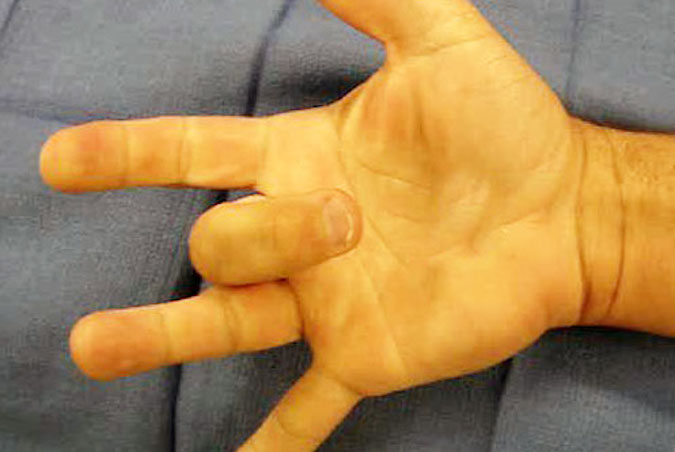 Locked right long trigger finger.
 -
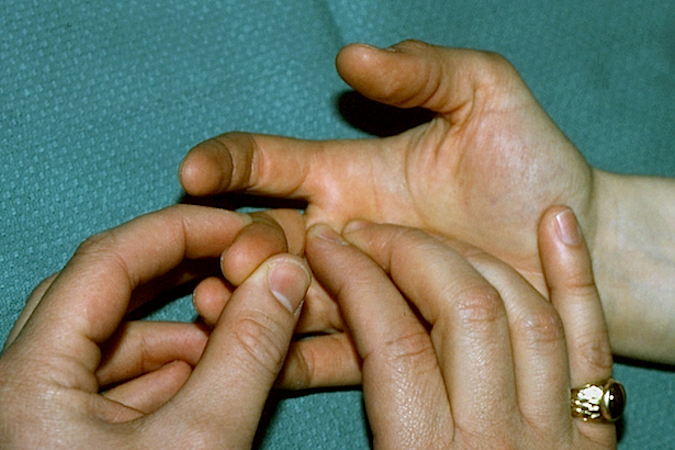 Right Long Trigger Finger Exam - Examiner is palpating A-1 pulley while passively flexing and extending the finger. Palpation should reveal tenderness and/or crepitus as the flexor tendon moves through the A-1 pulley in Section 7.
 -
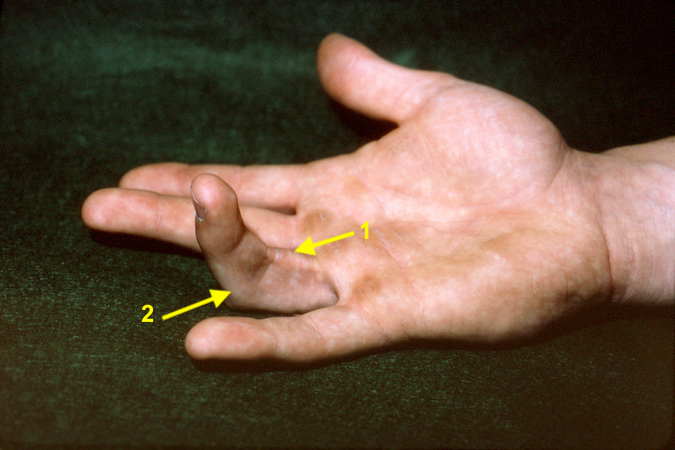 Chronic A-2 pulley rupture right ring finger with marked displaced flexor tendon (1) and PIP joint flexion contracture (2).
 -
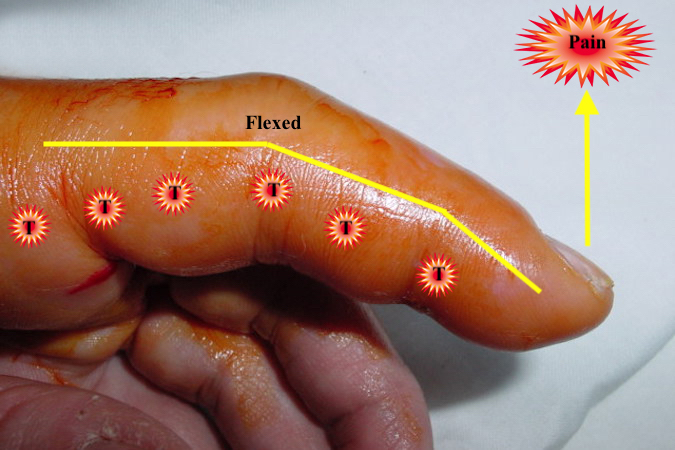 Flexor Tendon Sheath Infection with three Kanavel's Signs: tenderness (T) along the flexor sheath, finger in a flexed position, and pain with passive extension.
 -
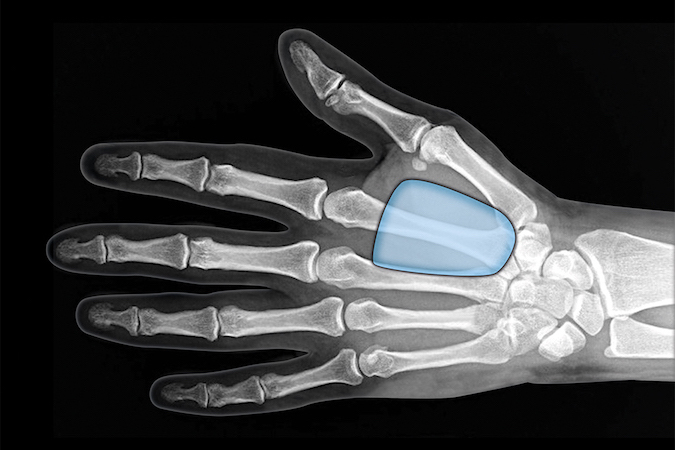 Thenar space
 -
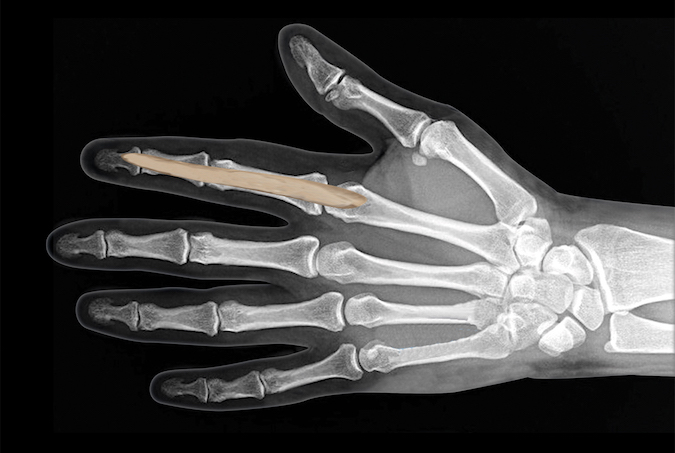 Index flexor tendon sheath which can rupture into the thenar space.
Key Points
- When a trigger finger is present there is tenderness at the A1 pulley area with catching, crepitus, and/or locking of the finger during active motion.
- When a trigger finger is surgically released, the A-1 pulley in section 7 is cut longitudinally.
- During trigger finger release only the A1 pulley should be released in order to avoid bowstring of the flexor tendons.
- When evaluating a patient for a flexor Tendon Sheath Infection look for Kanavel's Signs: tenderness along the flexor sheath, finger in a flexed position, and pain with passive extension.