Index, Long, Ring and Little Metacarpals Anatomy
- The metacarpals are small long bones of the hand.
- The base of the metacarpal, which is part of the CMC joint, and the distal head, which is part of the MP joint, are covered with articular cartilage.
- The metacarpal has five basic parts: The head or distal epiphysis, the neck or metaphysis, the shaft or diaphysis, the proximal metaphysis, and the base or proximal epiphysis.
- The proximal end of the metacarpals articulates with the bones of the distal carpal row.
- The distal end of the 2nd, 3rd, 4th, and 5th metacarpals articulate with the base of the 2nd, 3rd, 4th, and 5th proximal phalanges.
- The interosseous muscles are located between the metacarpals.
Diagrams & Photos
-
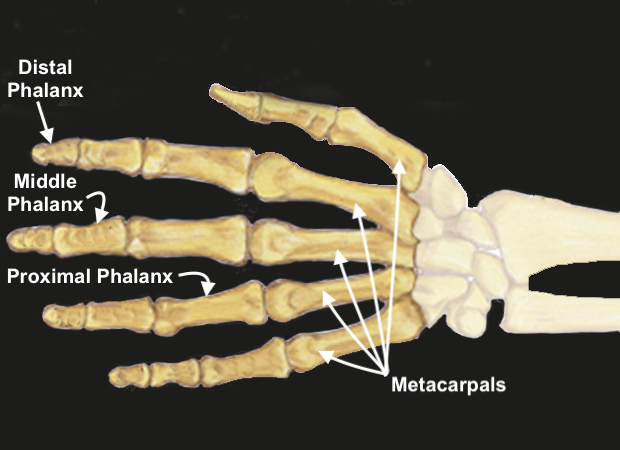 Metacarpal bones of the hand
 -
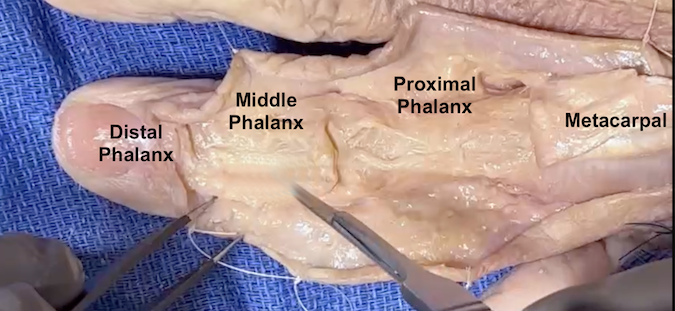 Dorsal dissection showing the index metacarpal head.
Key Points
- The fossae on the radial and ulnar sides of the metacarpal head are the origin site of the MP joint collateral ligaments.
- The thumb MP joint is the most commonly injured, with the border digits, index and long MP joints ranking second.
- Thumb MP dislocations usually occur in young, active individuals and the mechanism of injury in most cases is a fall on an outstretched hand (FOOSH) that causes forcible hyperextension of the MP joint.
- Most thumb MP dislocations are simple, meaning there is no soft tissue within the joint and the injury can usually be reduced by closed reduction.
- Complex dislocations occur less frequently but are more likely when the dislocation is in the volar direction, often from hyperflexion or a direct blow to the dorsum of the proximal phalanx.
- The metacarpal shaft (diathesis) is convex dorsally and concave on the palmar side.
- The second metacarpal base articulates with the trapezoid capitate and 3rd metacarpal and is the insertion site for the extensor carpi radialis longus tendon.
- The third metacarpal articulates with the capitate and is the insertion site of the extensor carpi radialis brevis tendon.
- The 4th metacarpal base articulates with the capitate and hamate.
- The 5th metacarpal base articulates with the hamate and is the insertion site of the extensor carpi ulnaris tendon.
- When using metacarpal intermedullary devices such as intermedullary screws, K-wires, or prosthetic stems the surgeon should be aware that the ring metacarpal has the smallest isthmus diameter. Note that the isthmus metacarpal diameters range from 3.4mm for the 5th metacarpal to only 2.7mm for the 4th metacarpal.
- In the growing child there is an epiphyseal plate in the base of the proximal phalanx.